
IT Cost
Cutting Guide
Everything you need to know
about saving money on IT
Table of Contents
INTRODUCTION
The cost of IT infrastructure and operations is a significant component of business IT budgets. The average SMB spends between $10,000 and $49,000 per year on technology. This figure illustrates that by reducing costs by a few percentage points, you can save your firm a considerable amount and better utilize your IT spend.
By any measure, however, this isn’t an easy task. Your IT systems and processes are all over the place, and it’s hard to determine by yourself exactly what needs improving.
The task of establishing new vendor relationships, determining IT support ROI, and identifying areas for cost reduction is a monumental one, so it’s okay to feel overwhelmed.
This is why partnering with a managed IT provider like Logic V is a great idea for determining your IT budget and executing your plan. Our team is capable of accelerating your IT operations, repurposing internal resources, and better optimizing your business processes.
We’ll outline best practices for reducing IT costs in this guide.
IT Department Best Practices
Here are some stats to consider before we get started:
Inefficiencies and redundancies plague IT spending the most. As a result, it’s crucial that you minimize IT overhead by building out cohesive processes that are controlled effectively.
IT spending is not equal across all business sizes. Despite having to spend more money on their IT, larger corporations build foolproof processes and leverage economies of scale better than small to mid-sized organizations.
This helps Chief Information Officers (CIOs) get more done with fewer resources. It is estimated that staffing costs are one of the greatest barriers to IT transformation, however, modern IT leaders have found that enterprise-level talent can be obtained without hiring in-house.
In this guide, we’ll explore ways to replicate this approach and share best practices for saving money on your IT services.
Get to Know The Role of IT In Your Company
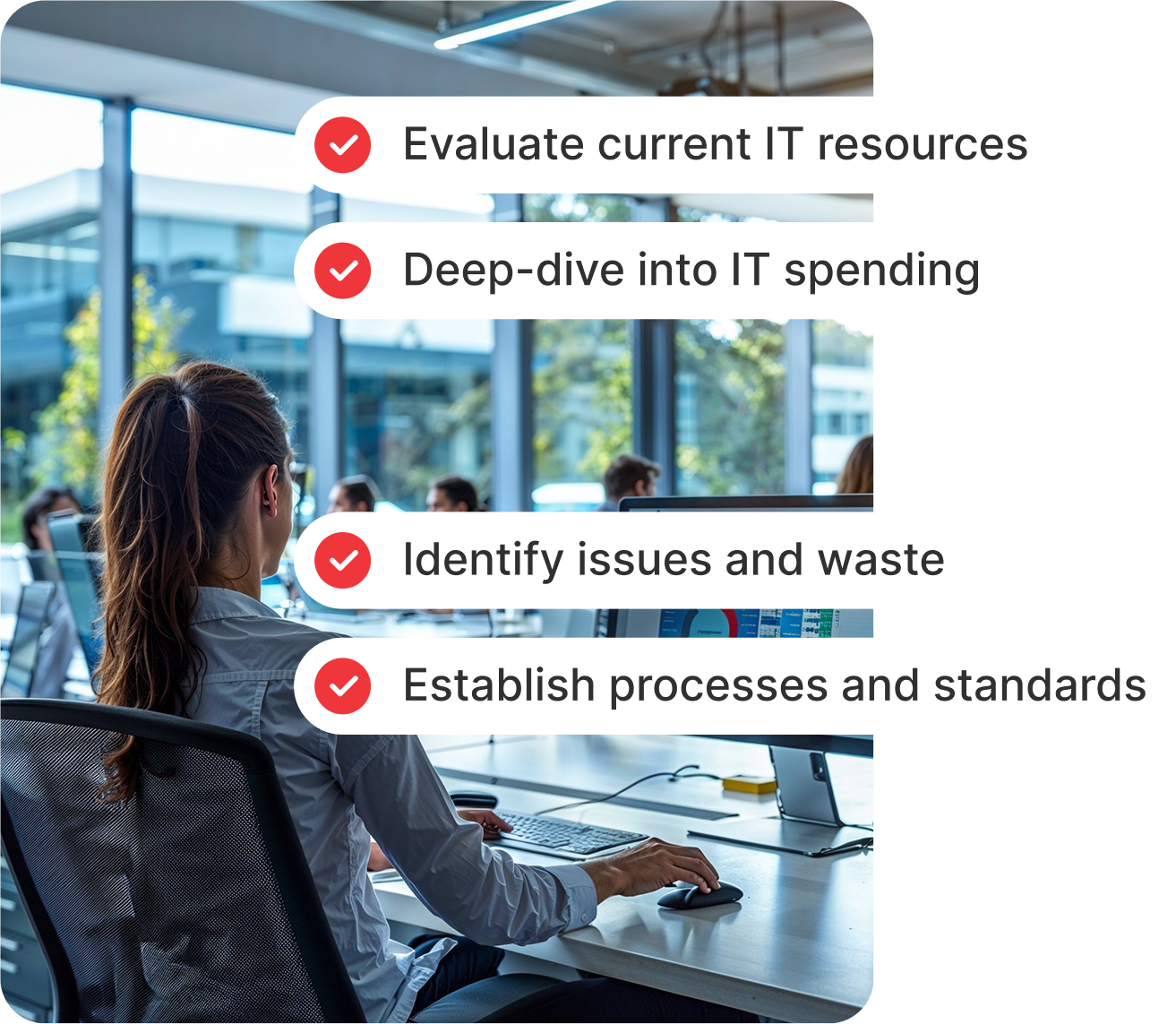
In order to reduce IT costs, you should first take a step back and examine how and to what extent you currently use each of your current IT resources.
The process of taking stock of this requires multiple conversations across your organization. As a result of these conversations, you will be able to identify existing IT bottlenecks, inefficiencies, department-specific pain points, and other factors that could be draining your budget.
Managed service providers (MSPs) like Logic V can help you with this process! Book your free consultation to learn more.
Implement Activity-Based Costing
In activity-based costing, specific value is assigned to activities within an organization. Your day-to-day activities are analyzed to determine how much IT costs overall so you don’t get stuck on fixed costs such as hardware and software.
Costs associated with a product or service are assigned based on activity. In this method of costing, relationships are recognized between:
● Costs
● Overhead activities
● Manufactured products
● Assigning indirect costs to products less arbitrarily than traditional costing methods
Using activity-based costing will give you an in-depth view of your IT spending, but you shouldn’t rely on it solely. In order to gain a holistic understanding, these insights should be evaluated alongside other data-driven metrics, such as organizational assessments.
Streamline Your Business Processes
Analyzing your existing processes and valuing their costs isn’t enough. An integrated approach also identifies what needs to be fixed as well as builds upon internal resources to improve what’s already there.
You can implement new productivity and process improvements as technology becomes an even more integral part of your workplace. And as these investments drive cost savings and efficiency improvements, they will pay off over time.
The Information Technology Infrastructure Library (ITIL) is a useful standard to keep in mind. In this document, IT best practices are equated with existing processes to help organizations manage IT with greater ease.
Make Use of Service Level Agreements (SLAs)
Service level agreements (SLAs) regulate the relationship between the IT department and other departments in your company.
Without one, you’re basically letting your IT department handle IT issues when they feel like it. Accountability and efficiency are improved by SLAs, which feature guaranteed response times, unlimited remote and on-site support, money-back guarantees, and more.
All stakeholders can be confident that the problem will be addressed and resolved in a timely manner as a result of these specific service standards.
READY TO GIVE US A TRY?
Most Companies Don’t Know Where They Are Overspending
Comb through invoices, streamline systems, improve the cost-effectiveness of your IT
Boost Uptime
It is important that your SLA outlines guarantees specific to the services utilized within your organization. Hardware, software, and cloud computing needs can be incorporated; and a minimum uptime standard should be specified.
For the success of your business, you need to ensure that your MSP can keep your IT services and processes stay up and running with an uptime guarantee. Having your systems offline would negatively impact customer service and business continuity - two very detrimental factors for your business.
For these reasons, a commitment to uptime levels and response times should be clearly outlined by your IT department or managed service provider.
Outline SLA Penalties
SLAs should be taken seriously and handled accordingly. These agreements are meant to protect you. They ensure that outsourced providers will be liable for penalties if they fail to meet the minimum guarantees outlined in your contract.
Depending on the provider, some providers offer cash payouts, while others offer a credit for the next payment. It is essential that this clause is inserted into the contract before it is signed and executed, regardless of the type of payout.
An opt-out clause can also be incorporated into an SLA penalty because the last thing you want is to be tied to an inefficient vendor. It is also possible for your contract with the vendor to be terminated if the vendor fails to meet SLAs consistently.
Implement Project Management Strategies
For organizations with advanced technology needs or complex IT systems spanning different departments, a project management team may be a good idea.
There are many ways that project managers can eliminate redundancies and drive cost savings within your company. They’ll identify and implement recommendations for fast growth without spending a lot of money because they’re laser-focused on business success.
Meanwhile, project managers use their experience in the industry to identify underperforming initiatives for elimination. This prevents cash from being thrown away unnecessarily and provides transparency into IT project performance.
In terms of IT budgeting, a robust project management strategy can reduce costs and eliminate inefficiencies. Let Logic V help you perfect your project management strategy.
Utilize Cloud Computing
Without proactively using cloud computing resources, your business misses out on many cost-saving opportunities. As you scale resources up and down, cloud computing will help you save on expensive hardware acquisitions (like physical, on-premises servers).
Your vendor is responsible for all maintenance and upkeep of the cloud infrastructure, so you don’t have to worry about patches or backups either.

Assessing the ROI of Your IT
It’s true that most organizations would like their IT department to drive revenue and ROI, but in reality, internal IT departments are more of a cost rather than an investment.
You can better save money and understand your ROI by handing your IT tasks off to an MSP. ROI metrics they will help you analyze include:
● IT downtime
● Volume of support tickets
● Time lost due to IT issues
● Industry averages
Utilize Cloud Computing
You can reduce the burden of managing IT by outsourcing it to managed IT service providers, as we mentioned earlier. You should, however, determine how much non-productive time you’ll invest before deciding to use one.
Find out how much time you spend managing each of the IT vendors you currently use on a monthly basis by:
1. Multiplying the numbers gives you a figure on the total number of hours.
2. Multiplying that by the average hourly compensation of the IT personnel responsible for managing the relationships with your vendors.
The overall calculation is as follows:
avg time managing vendor x total number of vendors x average hourly salary of staff x number of staff.

Using this calculation, you can determine how much it costs to manage vendor relationships. The next step is to extract a figure which reveals the total of performing IT functions. Calculate this by: hours spent by staff performing IT functions x average hourly salary of all IT staff.
You should also account for how much revenue was lost due to downtime. In order to do this, you need to determine how many hours your IT hardware and software assets have been inactive.
Once you have this number, multiply it by the average hourly employee salary at the location as well as the total number of employees. The end figure represents the cost of productivity loss from downtime.
The support for hardware devices and software solutions should also be added to the total monthly IT costs. You can then compare the total cost of outsourced and in-house IT to determine which one is best for your investment.
The final equation is as follows: Fixed IT Costs + Loss Productivity + Lost Revenues + Time Spent on IT Tasks + Cost of Managing Vendor Relationships = Total Cost of IT
Discover practical strategies to reduce IT costs without compromising performance, security, or growth.
Budget-Draining IT Oversights
IT support budgets must include more than just salaries. Take a look at some common unaccounted costs that can quickly drain your budget.
Overtime
It is not uncommon for IT support personnel to work a lot of overtime in order to resolve problems. IT failures usually have ripple effects across other departments. In the end, a number of systems may need to be fixed and stakeholders’ concerns may need to be addressed.
IT support budgets should include overtime costs, as this is an additional cost if your support team is in-house.
When you work with an outsourced vendor, you don’t pay a fixed hourly wage with benefits; instead, the provider is responsible for fixing problems as they arise.
Training
The cost of onboarding new employees for your internal department isn’t cheap.
Proper team training in areas such as security, infrastructure management, and more are essential to your system efficiency and budgeting should reflect this.
Recruiting
The cost of recruiting new employees should be considered along with training costs. Costs can quickly add up when posting job descriptions, screening resumes, conducting in-person interviews, and conducting background checks.
To avoid managing IT hiring internally, you may also consider outsourcing this task to specialists.

The Importance of Determining IT Costs
Understanding the role technology plays in your firm is critical when it comes to reducing your IT spend. A firm understanding of both your direct and indirect costs, as well as all IT internal resources, is required to achieve this.
At Logic V, our goal is to act as a trusted business partner for your business’s IT needs. Work with seasoned professionals who see and resolve wasted expenditures every day–from unused software licenses to entire storage arrays lying dormant!
Logic V
Headquarters
Suite 408, 938 Howe Street, Vancouver, BC, V6Z 2N9
Call Us
8886213763
© Copyright. All Rights Reserved.

